The Hospitality Staffing Crisis Is Structural
The hospitality industry lost millions of workers during the pandemic, and many never came back. As of 2026, hotels, restaurants, and event venues across the United States still cannot fill front-line roles at the rate they need. The Bureau of Labor Statistics reports that the accommodation and food services sector consistently posts among the highest job opening rates of any industry, with turnover remaining stubbornly above 70% annually.
This is not a temporary labor shortage waiting to correct itself. Demographic trends, wage competition from other sectors, and changing worker expectations have fundamentally altered the hospitality labor market. The properties that are thriving are the ones that have stopped waiting for the labor market to normalize and started rethinking how work gets done.
Autonomous robots are one of the most practical tools available for this rethinking — not because they replace hospitality workers, but because they handle the tasks that workers do not want to do and that pull them away from genuine guest interaction.
Three Proven Use Cases for Hospitality Robots
1. In-Room Delivery
Room service delivery is one of the most labor-intensive, low-margin services a hotel offers. A single delivery requires a staff member to prepare the tray, ride the elevator, navigate to the room, knock, wait, present the items, and return. Round-trip time for one delivery: 15–25 minutes. Multiply that across an evening and you are burning hours of labor on logistics, not hospitality.
Autonomous delivery robots handle this elegantly. The kitchen loads the order into the robot's enclosed compartment, enters the room number, and the robot navigates independently to the guest's door — riding elevators, avoiding obstacles, and calling the guest's room phone or sending a text notification upon arrival. The guest retrieves their items and the robot returns to base. No staff member leaves the kitchen or the front desk.
This is not limited to food. Hotels are using delivery robots for towel requests, toiletry replenishment, welcome packages, and late-night snack orders — all the small requests that interrupt staff workflow and create delays during peak periods.
2. Lobby and Common Area Cleaning
Hotel lobbies, conference corridors, dining areas, and fitness centers need continuous cleaning throughout the day. During peak check-in and check-out hours, lobby floors see heavy foot traffic and need attention precisely when front-desk staff are busiest with guests.
An autonomous cleaning robot running a scheduled loop through common areas handles this without pulling housekeeping staff from their room assignments. The robot sweeps and scrubs lobby floors during off-peak hours, cleans the breakfast area after service, and maintains corridors throughout the day. Because it operates quietly, it can clean alongside guests without disrupting the environment.
3. Restaurant and Dining Room Service
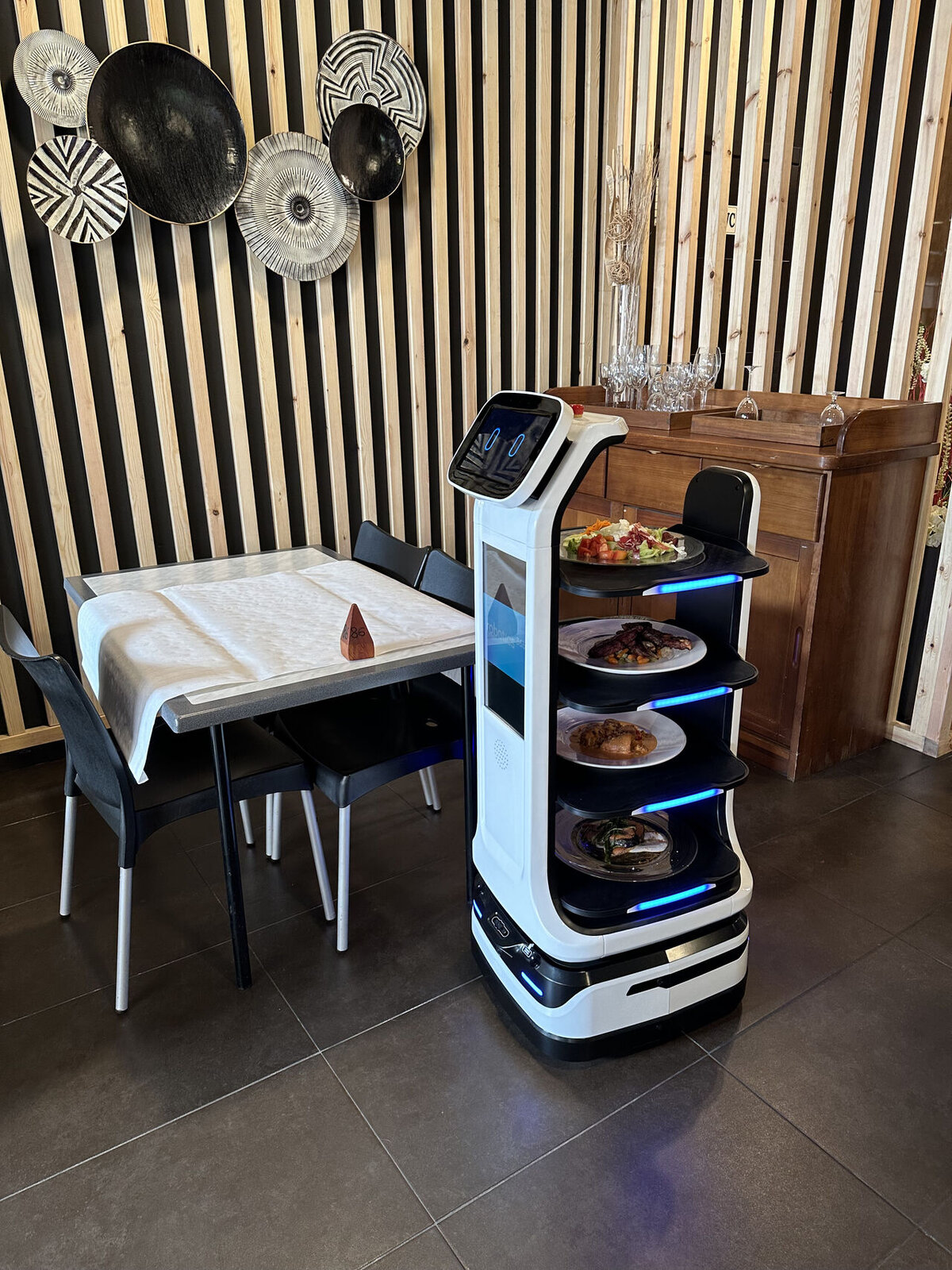
In hotel restaurants, resort dining rooms, and standalone restaurants, delivery robots serve as "runners" — carrying plates from the kitchen to serving stations, busing dirty dishes back, and delivering drink orders. This does not eliminate the server role; it amplifies it. Servers spend more time interacting with guests and less time carrying plates. A single delivery robot can effectively add 30–40% capacity to a serving team by handling the transport work.
The Guest Experience Factor
Counter to initial skepticism, guest feedback on hotel robots is overwhelmingly positive. Properties report that robots become a conversation starter, a social media moment, and a memorable part of the stay. Families with children are especially enthusiastic. The key is positioning the robot as a complement to human service, not a replacement — guests should always have the option to request a human interaction when they prefer it.
Choosing the Right Robots for Your Property
| Application | Robot Type | Key Requirements |
|---|---|---|
| Room Delivery | Enclosed-compartment delivery robot | Elevator integration, quiet operation, guest notification system, attractive design |
| Lobby & Common Area Cleaning | Autonomous floor scrubber/sweeper | Compact footprint, extremely quiet, premium appearance, multiple cleaning modes |
| Restaurant Running | Open-tray delivery robot | Multi-tray capacity, easy loading, obstacle avoidance in tight spaces, friendly interface |
| Event & Conference | Multi-purpose delivery robot | Flexible configuration, scheduled routes, branded appearance |
Implementation Best Practices for Hotels
Properties that get the best results from robot deployments follow a consistent pattern:
- Start with one high-impact use case. Do not try to roboticize everything at once. Pick the task that consumes the most staff time for the least guest-facing value — room delivery and lobby cleaning are the most common starting points.
- Brief your staff before the robots arrive. Explain what the robot does, what it does not do, and how it makes their jobs better. Staff who understand that the robot handles the tasks they dislike will champion its adoption. Staff who feel blindsided will resist it.
- Make it visible to guests. Do not hide the robot in service corridors. Let guests see it in action. Put the hotel's name or mascot on it. Make it part of the experience. Properties that embrace the robot as a feature rather than hiding it as infrastructure see the strongest guest satisfaction results.
- Collect and share the data. After 30 days, pull the reports: deliveries completed, hours of cleaning logged, staff hours freed up. Share these numbers with your team and with ownership. Concrete results make the case for expansion.
- Scale to additional use cases. Once the first deployment is running smoothly, add a second robot for a different task. Properties that deploy both a delivery robot and a cleaning robot see compounding efficiency gains because they are freeing staff across multiple departments simultaneously.
The Competitive Advantage
Hotels that deploy autonomous robots are not just solving a staffing problem — they are building a competitive advantage. In a market where every property competes on guest experience, a robot that delivers room service in 5 minutes (instead of 25), keeps the lobby spotless during peak hours, and generates social media buzz from delighted guests is a differentiator that is hard for competitors to match overnight.
The properties adopting this technology now are building operational muscle and guest loyalty that compounds over time. The properties that wait will eventually adopt too — but from a position of catching up rather than leading.
Bring Autonomous Service to Your Property
URG Americas offers the uServe delivery robot and uClean cleaning robots — both designed for guest-facing hospitality environments with German engineering and U.S. support.
Explore uServe Talk to Our Team