The Missing Link in Lab Automation
Laboratories have invested heavily in automating individual workstations — liquid handlers, plate readers, PCR machines, mass spectrometers. These instruments are highly sophisticated, capable of processing thousands of samples with precision and speed. But between these islands of automation, samples still move the old-fashioned way: carried by hand, placed on carts, walked down corridors by researchers and technicians.
This manual transport creates bottlenecks, introduces contamination risk, consumes skilled labor time, and breaks the chain of documentation. A researcher who spent years earning a PhD in molecular biology should not be spending 45 minutes of their day walking sample trays between instruments. Yet in most labs, this is exactly what happens.
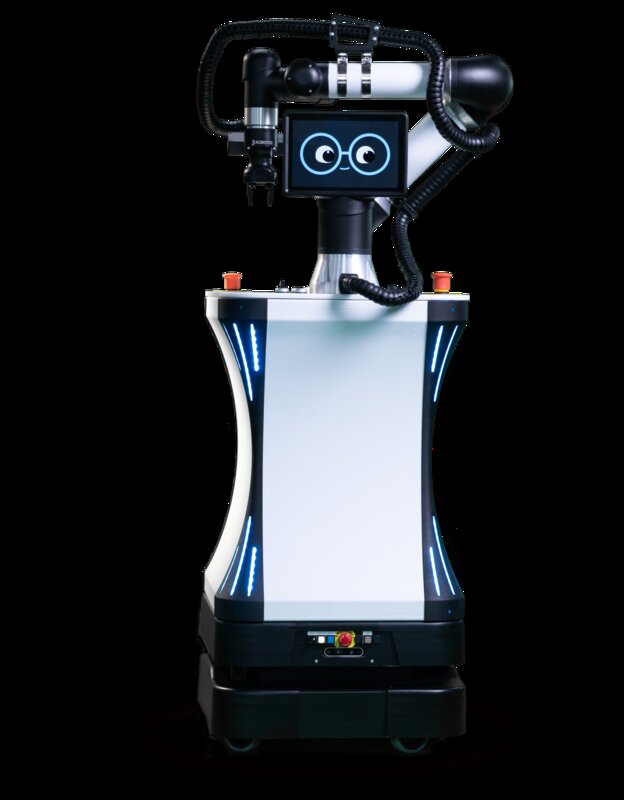
Autonomous mobile robots (AMRs) designed for laboratory environments close this gap. They transport samples, reagents, consumables, and waste between workstations, between rooms, and between floors — autonomously, traceably, and without consuming researcher time.
What Lab Mobile Robots Actually Do
Laboratory AMRs are purpose-built for scientific environments. They differ from warehouse robots or hospital delivery bots in several important ways: they are designed for clean environments, they handle sensitive and sometimes hazardous materials, they integrate with laboratory information management systems (LIMS), and they operate in spaces where precision and contamination control are paramount.
Core Functions
- Sample transport — Moving sample plates, tubes, and racks between instruments and workstations. The robot maintains chain of custody documentation automatically.
- Reagent and consumable delivery — Keeping workstations supplied with the materials they need without pulling researchers away from their work.
- Waste removal — Scheduled and on-demand pickup of biohazard waste, used consumables, and empty containers from workstations.
- Cross-floor transport — In multi-story lab buildings, robots can call and ride elevators to move materials between floors autonomously.
- Time-sensitive transfers — Some assays require samples to move between instruments within specific time windows. Robots execute these transfers on schedule, eliminating the risk of human delay.
Applications Across Lab Types
| Lab Type | Primary Transport Need | Key Benefit |
|---|---|---|
| Pharmaceutical R&D | Compound libraries, assay plates between screening instruments | Accelerates drug discovery pipeline throughput |
| Clinical / Diagnostic | Patient samples between analyzers, results to review stations | Reduces turnaround time and chain-of-custody gaps |
| Academic Research | Shared equipment access across multiple research groups | Maximizes utilization of expensive shared instruments |
| Quality Control | Production samples to testing stations, results documentation | Ensures consistent testing schedules and regulatory compliance |
| Biotech / Genomics | Sequencing prep, plate transfers, cold-chain management | Maintains sample integrity and timing requirements |
Unlock the rest of this guide
The remaining sections cover the ROI case, evaluation criteria, deployment planning, and the buyer’s checklist. Tell us where to send it and the full guide unlocks instantly.
We respect your inbox — no spam, just the guide and the occasional URG insight.
Evaluating Lab AMRs: What to Look For
- Cleanroom compatibility — Can the robot operate in ISO-classified environments? What is its particle emission profile? Can surfaces be wiped down with lab-grade disinfectants?
- Payload flexibility — Labs transport everything from single microplates to large reagent bottles. The robot should accommodate variable load sizes and weights.
- Navigation precision — Lab corridors are narrow and crowded with equipment carts. The robot needs centimeter-level positioning accuracy and reliable obstacle avoidance.
- LIMS and instrument integration — API access for connecting to your existing LIMS, ELN (electronic lab notebook), and instrument control software.
- Safety in sensitive environments — Emergency stop, containment protocols for spill scenarios, and safe operation around personnel in lab coats and PPE.
- Temperature control — Some samples require cold-chain maintenance during transport. Insulated or actively cooled compartments may be necessary.
Getting Started in Your Lab
Lab automation projects succeed when they start focused and expand based on results. Here is a practical approach:
- Map your transport workflows. Document every regular sample and supply movement: origin, destination, frequency, timing requirements, and who currently performs it.
- Identify the highest-value route. Look for the transport task that consumes the most skilled labor time, has the highest contamination risk, or creates the most frequent bottlenecks.
- Pilot on a single corridor or floor. Deploy one robot on your highest-value route for 60–90 days. Measure delivery accuracy, time savings, and researcher satisfaction.
- Scale with data. Use pilot results to build the business case for expanding to additional routes, floors, and buildings.
The labs that are gaining the most from mobile robotics started small, proved the concept quickly, and expanded systematically. The technology is ready. The question is whether your lab is ready to stop using PhD-level talent as delivery couriers.
Explore Mobile Robotics for Your Laboratory
The URG Americas uLab platform is purpose-built for laboratory environments — with navigation precision, cleanroom compatibility, and LIMS integration designed for life sciences.
Explore uLab Talk to Our Team