The Hidden Cost of Manual Sample Transport
The clinical laboratory workforce is stretched thin, and much of the industry conversation is about how to keep skilled technologists doing skilled work. Yet in most labs a real share of every shift still goes to walking specimens, plates, and consumables from one station to the next.
That transport time is expensive because it is performed by the same trained professionals who are hardest to hire and retain. Every trip a technologist makes across the lab to move a rack is time not spent on analysis, review, or quality work that only they can do.
Where Transport Time Goes in a Lab
Sample movement is constant: from accessioning to sorting, to extraction and prep, to the analyzers, and on to storage. Add stat samples that jump the queue, reruns, and consumable restocking, and the walking adds up quickly across a day.
Manual transport also introduces variability. A rack can sit waiting for someone to become free to carry it, which quietly extends turnaround time. The bottleneck is rarely the instrument, it is the handoffs between steps.
How Autonomous Mobile Transport Works
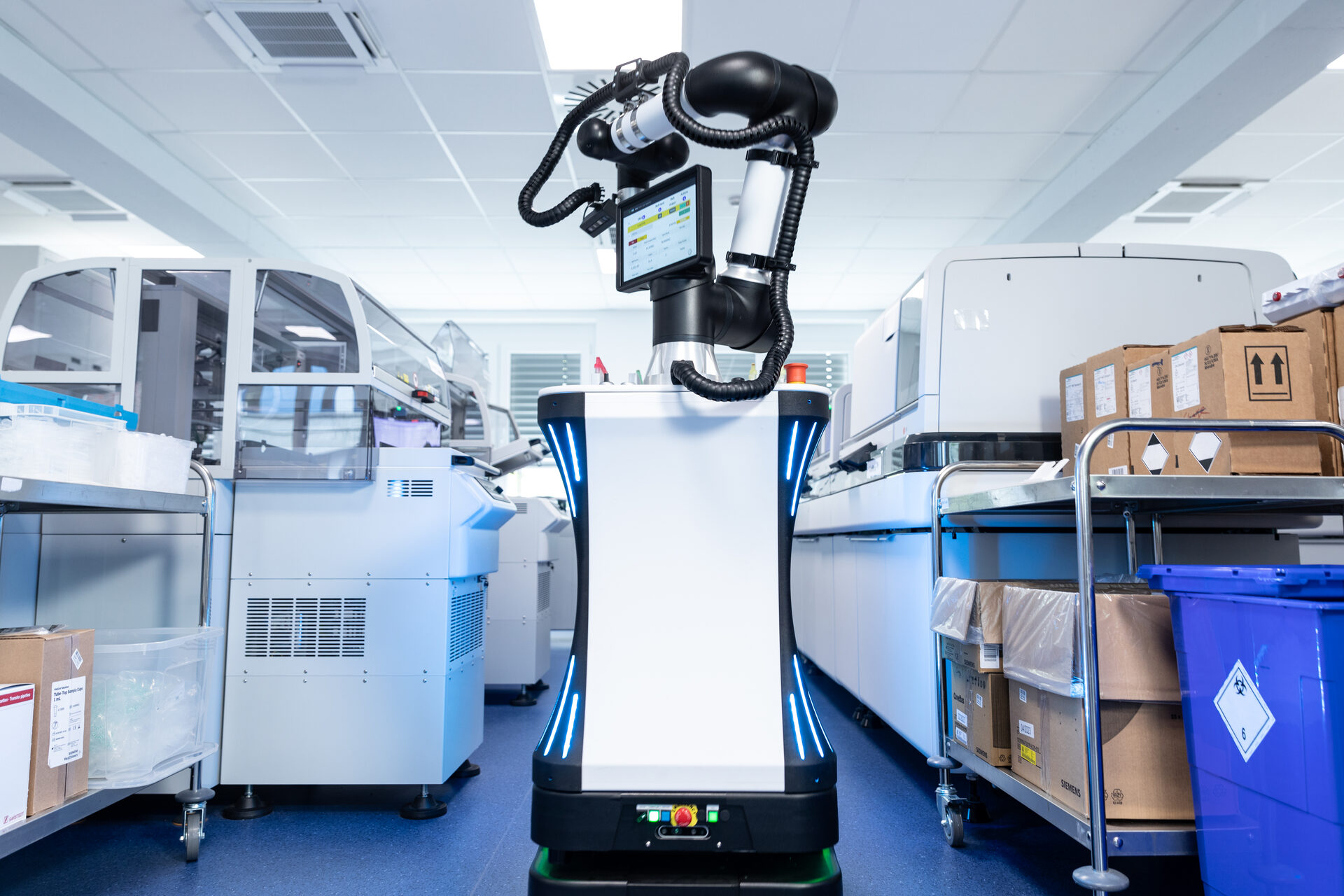
An autonomous mobile robot navigates the lab on its own, carrying specimens and materials between stations on a defined route or on demand. It maps the space, avoids people and obstacles, and can be called to a station when a batch is ready to move.
Because the robot runs the same route reliably every time, the movement between steps becomes predictable rather than dependent on who is available. Trained scientists stay on the bench, and the materials keep moving even during busy stretches.
Chain of Custody and Turnaround Time
In a clinical setting, tracking matters as much as speed. An autonomous transport workflow can log a time-stamped record of each pickup and drop-off, creating a clear chain of custody for every handoff rather than relying on memory or paper.
The turnaround benefit comes from removing the wait. When samples move on a consistent cadence instead of waiting for a free pair of hands, the time between steps compresses, and the whole workflow becomes easier to measure and improve.
Integration with Lab Workflows
Automation works best when it fits the way the lab already runs. That means mapping the real routes samples take, identifying the busiest and most repetitive legs, and starting there rather than trying to automate everything at once.
The most repetitive, highest-volume route is usually the best first candidate. It delivers the clearest time savings and gives the team a concrete result to build on before expanding to additional routes.
Getting Started with a Single Route
You do not need to automate the entire lab to see value. The lowest-risk path is to pick one busy route, measure the technologist hours it currently consumes, and put an autonomous unit on that route to measure what it gives back.
uLab Mobile is designed for exactly this: moving specimens and materials between accessioning, prep, and analysis, and tending instruments on a signal. On our Robots-as-a-Service model you can prove it on one route at a fixed monthly cost, then expand without a capital project.