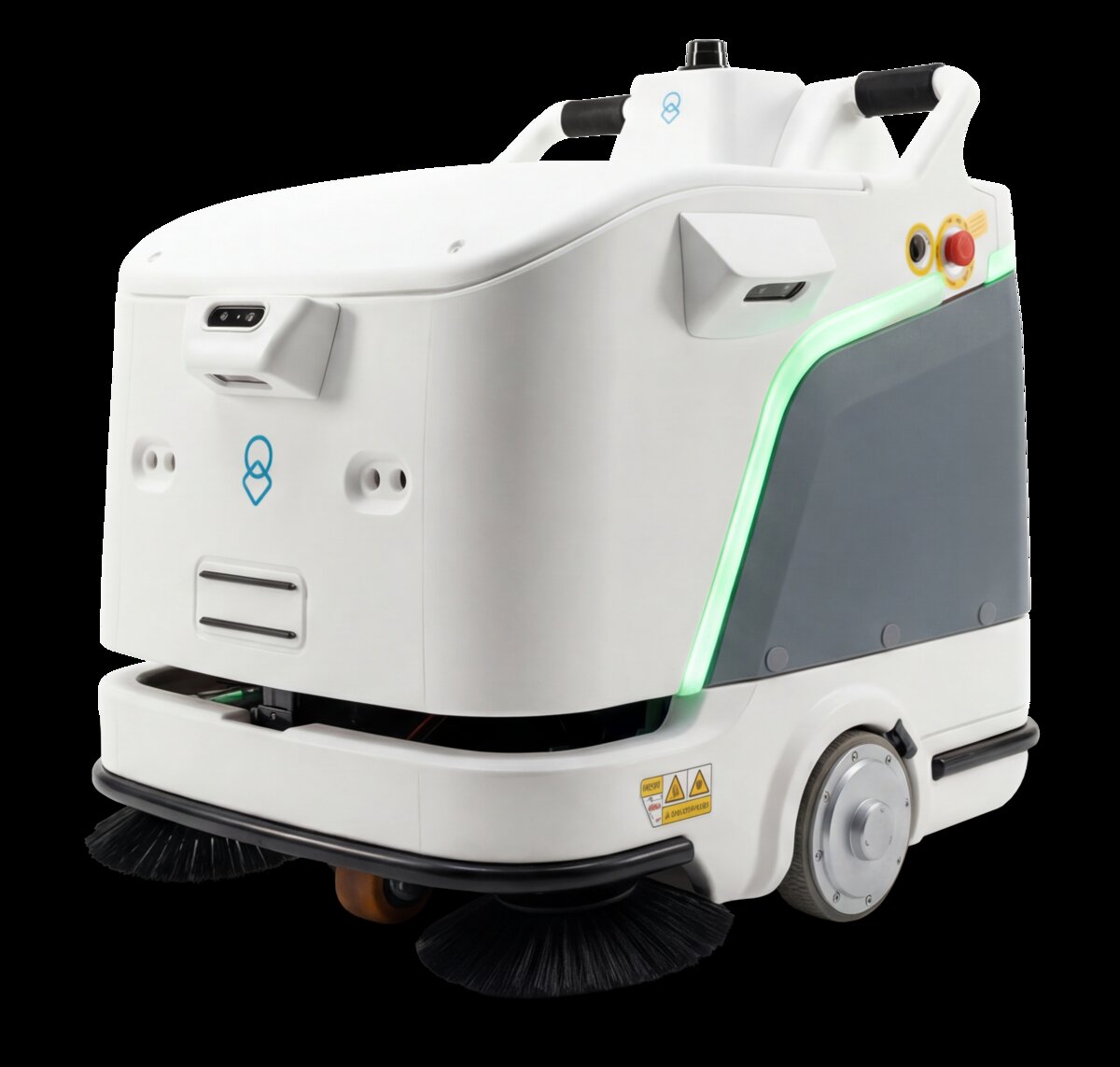
Total Cost of Ownership Framework
Comparing manual and robotic cleaning isn't about purchase price—it's about total cost of ownership (TCO) over the asset's lifetime. TCO includes every dollar spent: initial equipment, labor, supplies, maintenance, and indirect costs like staff turnover and quality variance.
Manual cleaning TCO = Labor costs + Equipment costs + Supplies + Indirect costs
Robotic cleaning TCO = Robot purchase + Installation + Software licenses + Maintenance + Supplies + Labor (reduced)
The key insight: labor dominates manual cleaning costs. Labor is relatively fixed (you must pay staff whether productivity is high or low), while robotic systems spread their upfront cost over thousands of labor hours saved. As a facility grows, robots become increasingly cost-effective.
Labor Costs: Wages, Benefits, Turnover
This is the largest cost driver. Let's break it down realistically.
Hourly Wages
A commercial cleaning technician in the U.S. earns $16–$22/hour depending on region and experience. This varies:
- Urban markets (NYC, SF, LA): $20–$26/hour
- Mid-tier cities: $16–$18/hour
- Rural areas: $14–$16/hour
For this analysis, we'll use $18/hour as a baseline.
Benefits and Overhead
Employers must add:
- Payroll taxes (FICA): 7.65%
- Health insurance: $300–$400/month (~$4,500/year) per full-time worker
- Workers' compensation: ~$1,200/year
- Uniforms and PPE: ~$300/year
- Supervision and scheduling: ~$2,000/year
- Total benefits/overhead per FTE: ~$8,500–$10,000/year
Fully-loaded labor cost = $18/hour + benefits = ~$23–$27/hour (~$48K–$56K fully-loaded annual cost per FTE)
Turnover Costs
Turnover in commercial cleaning is notoriously high: 40–60% annually. Costs include:
- Recruiting and hiring: $500–$1,000 per hire
- Training new staff: ~20 hours at fully-loaded rate = ~$500
- Lost productivity during ramp-up: ~$1,500
- Inconsistent quality (new staff are slower): 10% efficiency loss for first 3 months
- Total turnover cost per separation: ~$2,500–$4,000
If you employ 5 cleaners and 50% turn over annually, you replace 2.5 workers/year × $3,500 = $8,750 in turnover costs alone.
Equipment Costs: Manual vs. Robotic
Beyond labor, equipment investment differs significantly.
Manual Equipment
- Upright or backpack vacuum: $500–$2,000 per unit × 2–3 units = $1,500–$5,000
- Floor scrubber/burnisher: $2,000–$8,000 (if needed) × 1–2 units = $2,000–$16,000
- Mops, buckets, and hand tools: $1,000/year
- Storage racks and equipment room: $2,000 (one-time)
- Year 1 equipment cost: $8,500–$28,000
- Annual replacement/refresh: ~$3,000–$5,000
Robotic Equipment
- uClean C-Dry robot: $45,000
- uClean L-Dry robot: $65,000
- Charging dock and scheduling software: $3,000–$5,000
- Installation and network setup: $2,000–$5,000
- Year 1 robot cost: $50,000–$80,000 (for one robot)
- Annual maintenance (parts, support): ~$2,500–$4,000
Consumables and Maintenance
Both systems require ongoing supplies, but the patterns differ.
Manual Cleaning Consumables
- Detergents and cleaning chemicals: $200–$400/month = $2,400–$4,800/year
- Microfiber cloths, mop heads (replacement): $500/year
- Vacuum bags/filters: $300/year
- Trash liners: $200/year
- Annual consumables: ~$4,000–$6,000
Robotic Cleaning Consumables
- Water and detergent for clean water tanks: $100–$200/month = $1,200–$2,400/year
- Brush roller replacements: $400–$800/year (every 300–500 hours)
- Filter cartridges: $300–$500/year
- Wheel/tire replacements: $500/year
- Annual consumables: ~$2,400–$4,200
Maintenance Costs
- Manual: Minimal ($100–$300/year for equipment repair)
- Robotic: Preventive maintenance program ($1,500–$3,000/year) + emergency repairs if not preventive
Three Facility Size Scenarios
Now let's model three real-world facility types over 5 years.
Scenario 1: Small Office (25,000 sq ft)
Cleaning profile: Daily daytime cleaning. 1 full-time cleaner + 0.5 part-time. ~6 hours/day coverage.
| Cost Category | Manual (Annual) | Robotic (Annual) |
|---|---|---|
| Salaries + Benefits (1.5 FTE) | $72,000 | $15,000 |
| Equipment (amortized) | $3,000 | $16,000 |
| Supplies and Consumables | $5,000 | $3,000 |
| Turnover/Training Costs | $5,000 | $0 |
| Supervision/Management | $3,000 | $1,000 |
| Total Annual Cost | $88,000 | $35,000 |
5-Year Summary: Manual = $440,000 | Robotic = $175,000 | Savings: $265,000 (60%)
Scenario 2: Mid-Tier Facility (50,000 sq ft)
Cleaning profile: Daily daytime + evening cleaning. 3 full-time cleaners + 1 part-time. 12 hours/day coverage.
| Cost Category | Manual (Annual) | Robotic (Annual) |
|---|---|---|
| Salaries + Benefits (4 FTE) | $192,000 | $30,000 |
| Equipment (amortized) | $6,000 | $24,000 |
| Supplies and Consumables | $9,000 | $5,000 |
| Turnover/Training Costs | $14,000 | $0 |
| Supervision/Management | $8,000 | $2,000 |
| Total Annual Cost | $229,000 | $61,000 |
5-Year Summary: Manual = $1,145,000 | Robotic = $305,000 | Savings: $840,000 (73%)
Scenario 3: Large Facility (100,000 sq ft)
Cleaning profile: 24-hour multi-shift cleaning. 8 full-time cleaners + 2 part-time + supervisor. Heavy floor care.
| Cost Category | Manual (Annual) | Robotic (Annual) |
|---|---|---|
| Salaries + Benefits (10 FTE) | $480,000 | $60,000 |
| Equipment (amortized) | $12,000 | $40,000 |
| Supplies and Consumables | $18,000 | $8,000 |
| Turnover/Training Costs | $35,000 | $0 |
| Supervision/Management | $18,000 | $5,000 |
| Total Annual Cost | $563,000 | $113,000 |
5-Year Summary: Manual = $2,815,000 | Robotic = $565,000 | Savings: $2,250,000 (80%)
Break-Even Analysis and Timelines
When does investing in robots pay for itself?
Small Office (25,000 sq ft)
- Year 0: Robot investment ($50K) + first-year costs ($35K) = $85K
- Year 1: Manual cost $88K vs. Robot cost $35K = $53K savings
- Year 2: Accumulated savings = $106K (breakeven achieved late Year 2)
- Break-even timeline: 18–22 months
Mid-Tier Facility (50,000 sq ft)
- Year 0: Robot investment ($75K for 2 robots) + first-year costs ($61K) = $136K
- Year 1: Manual cost $229K vs. Robot cost $61K = $168K savings
- Year 2: Accumulated savings = $336K (breakeven achieved mid-Year 1)
- Break-even timeline: 8–10 months
Large Facility (100,000 sq ft)
- Year 0: Robot investment ($200K for 3 robots) + first-year costs ($113K) = $313K
- Year 1: Manual cost $563K vs. Robot cost $113K = $450K savings
- Year 2: Accumulated savings = $900K (breakeven achieved mid-Year 1)
- Break-even timeline: 8–9 months
Key insight: Larger facilities see faster payback because labor cost reductions dominate. In a 100,000 sq ft facility, eliminating 8–10 FTE saves $480K/year—far exceeding robot costs.
Hidden Costs People Miss
Beyond the spreadsheet, several real costs often go uncounted:
Manual Cleaning Hidden Costs
- Quality variance: Staff sick days, low-motivation periods, and high turnover mean cleaning quality fluctuates. Poor cleaning harms your brand and customer experience. This is hard to quantify but real.
- Liability: Worker injuries during cleaning (back strain, slip/fall) cost $3,000–$15,000 per incident in workers' comp claims, lost productivity, and legal fees.
- Management overhead: Scheduling, payroll, performance management, and HR burden consume significant time. We underestimate the cost of 30% of a facilities manager's salary.
- Regulatory compliance: Background checks, safety training documentation, and certifications add ~$1,000–$3,000/year per employee.
Robotic Cleaning Hidden Costs
- Integration effort: Configuring robots for your specific facility layout, scheduling software, and workflows takes 20–40 hours. Cost: ~$1,500–$3,000.
- Staff retraining: Existing staff must learn to work alongside robots, charge batteries, respond to errors. Budget 5–10 hours per employee.
- Initial quality dip: New robots may miss spots or move slowly during the learning curve. Expect 2–4 weeks of quality adjustment.
- Space and infrastructure: Robot charging stations, storage, and network improvements may cost $3,000–$10,000.
The Real Hidden Benefit
Robots never call in sick, never resign, never require performance management, and never perform worse on Mondays. This consistency is priceless. Facilities with robots report higher customer satisfaction scores and lower liability claims due to improved, predictable cleaning quality.
5-Year Projection Tables
Here's a detailed year-by-year breakdown for the mid-tier facility (50,000 sq ft), the most common scenario:
Manual Cleaning 5-Year Cost Projection
| Year | Labor | Equipment | Supplies | Turnover | Other | Total | Cumulative |
|---|---|---|---|---|---|---|---|
| 1 | $192K | $6K | $9K | $14K | $8K | $229K | $229K |
| 2 | $198K | $6K | $10K | $15K | $8K | $237K | $466K |
| 3 | $204K | $6K | $10K | $15K | $8K | $243K | $709K |
| 4 | $211K | $7K | $11K | $16K | $9K | $254K | $963K |
| 5 | $218K | $7K | $11K | $17K | $9K | $262K | $1,225K |
Robotic Cleaning 5-Year Cost Projection
| Year | Robot | Labor | Equipment | Supplies | Other | Total | Cumulative |
|---|---|---|---|---|---|---|---|
| 0 (Year 1 - Capex) | $75K | $30K | $5K | $5K | $2K | $117K | $117K |
| 2 | $0 | $31K | $3K | $5K | $2K | $41K | $158K |
| 3 | $0 | $32K | $3K | $5K | $2K | $42K | $200K |
| 4 | $0 | $33K | $4K | $6K | $2K | $45K | $245K |
| 5 | $0 | $34K | $4K | $6K | $3K | $47K | $292K |
| TOTAL 5-YEAR SAVINGS: | $933,000 (76% reduction) | ||||||
The Bottom Line
For facilities of 25,000 sq ft and larger, robotic cleaning delivers measurable savings within 12–24 months and compounds over time. A mid-size 50,000 sq ft facility saves nearly $1 million over 5 years—equivalent to hiring an additional full-time employee every year while improving service quality.
But the math isn't universal. Small facilities (under 10,000 sq ft) may not justify robots purely on labor economics. Conversely, large facilities (150,000+ sq ft) see accelerating returns as deployment of 4–5 robots reduces workforce by 50%+ while maintaining or improving cleaning quality.
Use these frameworks with your actual cost data. Track your labor hours, wage rates, turnover, and supply costs for 6 months. Then plug those numbers into this model. Your real ROI is likely to be compelling.