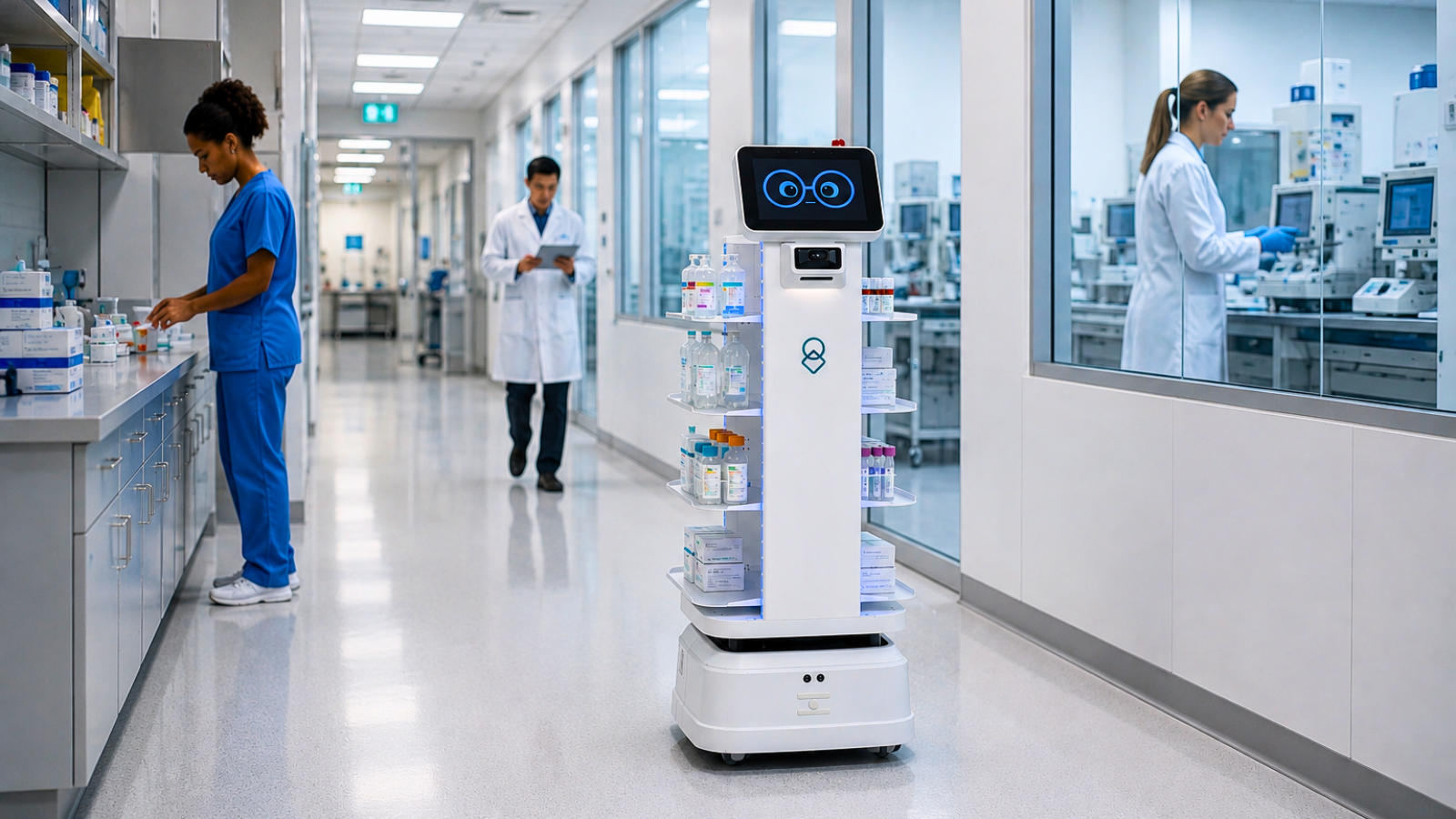
The Hospital Logistics Problem: How Much Time Is Really Wasted?
Healthcare facilities are facing a crisis that's less visible than a bed shortage but equally consequential: non-clinical logistics consuming up to 30% of nursing time. In understaffed hospitals, this inefficiency directly translates to delayed patient care, increased nurse burnout, and operational costs that erode already-thin margins.
Consider a typical nursing shift. Between patient care, clinicians spend significant time on repetitive, non-clinical tasks: delivering supplies from central storage, transporting lab specimens to the lab, fetching medications from the pharmacy, delivering clean linens, retrieving meal trays, and moving case carts between units. These journeys happen dozens of times per shift, per nurse. In a 400-bed hospital, that's thousands of miles walked daily by clinical staff for deliveries alone.
30%
Nursing time on non-clinical logistics
4-6 hrs
Daily walking distance per nurse
1000s
Daily deliveries in large hospitals
The True Cost of Manual Logistics
Beyond time consumption, manual logistics create cascading operational problems. Lab specimens delayed in transport lead to slower test results. Medication deliveries queued up at the pharmacy cause treatment delays. Dirty linens accumulating on units create infection control risks. Supply shortages on floors force nurses to improvise or make extra trips. Each inefficiency compounds the others.
Hospitals have tried traditional solutions—increasing staffing, optimizing supply chains, redesigning storage systems—with limited results. The fundamental issue remains: someone must physically move items between locations, and that someone is currently nursing staff who should be at bedsides.
How Autonomous Delivery Robots Work in Hospital Environments
Autonomous hospital delivery robots are purpose-built mobile platforms designed to navigate indoor hospital environments safely and reliably. Unlike industrial robots in manufacturing or consumer robots in offices, hospital delivery systems must navigate complex, dynamic environments while maintaining strict safety standards in a clinical setting.
Core Technology and Capabilities
Navigation systems use advanced sensors (LIDAR, cameras, ultrasonic) to create real-time maps of their environment. This allows robots to detect obstacles, avoid collisions, and plan efficient routes even as hallways fill with people, equipment, and unexpected obstacles. The system learns your facility's layout and continuously updates its understanding as renovations or reconfigurations occur.
Payload capacity varies by model. The uLog Deliver 80 carries 80 kg (176 lbs), suitable for linens, supplies, and paperwork. The Deliver 150 and 300 models scale up for larger material handling needs. The Deliver 300XL, our largest platform, accommodates specialized carts and containers for bulk deliveries. This means different robot models can handle different delivery types throughout your facility.
Speed and efficiency are optimized for hospital environments. Robots move at 1-1.5 m/s (3-5 km/h), fast enough to be useful but slow enough to be safe around pedestrians and equipment. A single robot can complete 15-25 deliveries per hour depending on facility layout and destination clustering.
Fleet management systems coordinate multiple robots automatically. A centralized dispatch system receives delivery requests (electronically or via mobile app), queues them intelligently, and assigns robots based on current location, battery status, and payload capacity. As one robot completes a delivery, it automatically picks up the next task. No manual coordination required.
Delivery Scenarios Robots Handle
| Delivery Type |
Current Process |
With Robots |
| Pharmacy |
Nurse walks to pharmacy, waits for batch, carries doses back |
Robot picks up automated batch, delivers to unit |
| Lab Specimens |
Nurse collects samples, carries to lab (time-sensitive) |
Robot transports in secure container, maintains chain of custody |
| Clean Linens |
Nurse fetches from central laundry multiple times daily |
Robot delivers linen carts to units on schedule |
| Supplies & Equipment |
Nurse retrieves from storage when needed (often rushed) |
Robot delivers to unit, restocks par levels automatically |
| Meals & Trays |
Dietary staff or nurse delivers trays room-by-room |
Robot delivers to unit, nursing delivers to patient rooms |
| Waste & Biohazards |
Nurse segregates and carries to disposal area |
Robot transports to collection point for proper disposal |
System Integration: Elevators, Doors, and Clinical Workflows
Autonomous delivery robots can't simply be introduced to a hospital—they must integrate seamlessly into existing clinical workflows, building systems, and daily operations. This integration is more complex than many organizations anticipate, but it's essential for success.
Elevator Integration
In multi-story hospitals, robots must use elevators independently. This requires integration with your building control system. Hospitals typically implement one of two approaches:
- Elevator API integration: The robot's fleet management system communicates directly with your elevator system, requesting a car and calling it to the robot's current location. The robot enters the elevator, and the system automatically selects the destination floor, then exits when the door opens.
- Dedicated elevator access: Designate specific elevator(s) for robot use during certain hours, simplifying technical complexity though reducing flexibility.
Modern elevators support this integration with relative ease. Older systems may require upgrades to the building control system, which should be assessed during your planning phase.
Door Access and Authentication
Robots must move through secure areas: medication cabinets, specimen storage, sterile supply rooms. Access control integration allows robots to unlock doors using the same credential systems (RFID, key card, API) your staff currently use. The robot carries a credential and uses it to open restricted doors, maintaining security while enabling autonomous movement.
For some areas, human staff may remain as a gating control—robots can't access operating room suites or isolation units without staff authorization. This maintains flexibility while still automating routine traffic.
Clinical Workflow Integration
The most important integration is behavioral and operational. Staff must be able to request deliveries from existing systems (EHR integration, mobile app, physical request buttons) and understand how the robot responds. Key design principles include:
- Zero disruption to clinical workflows: Robots operate in background; staff don't change how they work
- Predictable delivery times: Fleet management systems can estimate delivery ETA so staff know when to expect a delivery
- Safe hand-offs: Clear protocols for how staff place items into/remove items from the robot
- Exception handling: Robots can't complete all tasks autonomously; staff must understand when to intervene
Infection Control and Hygiene Considerations
Infection prevention is paramount in hospitals. Any new piece of equipment—especially one moving between patient areas—introduces potential contamination pathways. Hospitals naturally ask: "Are these robots safe in terms of infection control?"
Design for Cleanability
Hospital-grade delivery robots are designed with cleaning and disinfection in mind. Surfaces are smooth, without crevices where pathogens can hide. Materials are compatible with standard hospital disinfectants (quaternary ammonium, hypochlorite, etc.). The external casing can be wiped down quickly using standard procedures, just like mobile carts or equipment.
Recommended cleaning protocols:
- Daily surface disinfection with hospital-approved disinfectant wipes
- Deep cleaning/disinfection weekly or when visibly soiled
- Enhanced cleaning after high-contamination tasks (biohazard transport)
- Protocol for disinfection if robot enters isolation unit
Containment Systems
For sensitive cargo (lab specimens, medications, biohazards), robots can carry sealed containers that protect both the cargo and the robot's surfaces. This is especially important for:
- Specimen transport: Secure biohazard containers maintain specimen integrity and prevent spills
- Medication delivery: Sealed containers protect medications from contamination
- Waste transport: Sealed bags or containers keep biohazard material contained during transport
Prevention of Cross-Contamination
Hospitals should implement workflow protocols that minimize cross-contamination risk:
- Robots serving high-contamination areas (isolation units, wound care) are cleaned before visiting clean areas
- Different robots or different loading times segregate clean vs. contaminated deliveries
- Colored markers or designated spaces prevent mixing of cargo types
- Staff training emphasizes proper handling and hand hygiene after robot interaction
Infection control teams should evaluate your planned robot deployment during the pilot phase and establish protocols accordingly. Most hospitals find that properly managed robots pose no increased infection risk compared to equipment carts moved by staff.
FREE GUIDE — CONTINUE READING
Unlock the rest of this guide
The remaining sections cover ROI calculation frameworks, the key features to evaluate, 24/7 deployment planning, staff-adoption strategy, and a real-world implementation playbook. Tell us where to send it and the full guide unlocks instantly.
We respect your inbox — no spam, just the guide and the occasional URG insight.
Measuring ROI: Time Savings and Operational Impact
The financial case for hospital delivery robots is compelling, but ROI calculation requires understanding both direct and indirect benefits.
Direct Time Savings
A single autonomous delivery robot can eliminate 5-8 full-time equivalent (FTE) nursing hours per day through eliminated walking, waiting, and manual delivery tasks. In a 400-bed hospital operating multiple robots:
- 4 robots: 20-32 FTE hours recovered daily (~2.5-4 FTE positions)
- 6 robots: 30-48 FTE hours recovered daily (~3.75-6 FTE positions)
- 10 robots: 50-80 FTE hours recovered daily (~6.25-10 FTE positions)
Recovered time doesn't mean layoffs; it means those nursing hours redirect to patient care, patient safety, and reduced overtime costs. A single prevented adverse event from a nurse having time to properly assess a patient often justifies the entire robot investment.
Operational Efficiency Gains
Beyond time savings, robots improve operational metrics:
Pharmacy Turnaround
Average time from order to delivery reduces from 15-20 minutes (manual) to 5-7 minutes (autonomous). This particularly benefits stat medications and emergency deliveries.
Lab Specimen Processing
Time-to-result metrics improve when specimens reach the lab faster. Faster results mean earlier treatment, especially critical in emergency and ICU settings.
Supply Chain Efficiency
Automated restocking reduces stock-outs on units. When floor inventory is reliably maintained, staff don't waste time hunting for supplies.
ROI Calculation Framework
A typical 400-bed hospital with 4-6 robots sees payback periods of 3-5 years:
| Cost Category |
Typical Cost |
| Robot Capital (4 units) |
$800,000 - $1.2M |
| Installation/Integration |
$150,000 - $300,000 |
| Training & Change Mgmt |
$50,000 - $100,000 |
| Annual Maintenance |
$80,000 - $120,000/year |
| Annual Nursing Cost Savings (3-4 FTE) |
$300,000 - $400,000/year |
Additional benefits often include reduced nurse turnover (improved retention saves training costs) and potential reduction in patient adverse events from improved nursing attention—both significant but harder to quantify.
Key Features to Evaluate in Hospital Delivery Robots
Not all autonomous robots are equal. When evaluating systems, prioritize features that matter in healthcare environments.
Payload Capacity and Flexibility
Your facility has diverse delivery needs. Evaluate whether a single robot model meets all needs or whether multiple models are required. Consider:
- Does it fit through your doorways and fit in your elevators?
- Can it carry your largest typical delivery (linen carts, meal trays, supply bins)?
- Can you attach different containers/payload systems for different delivery types?
Safety and Collision Avoidance
Hospitals are crowded environments. Your robot must detect and stop for people, equipment, obstacles in real-time. Evaluate:
- Does it have redundant sensor systems (not dependent on single sensor type)?
- How does it handle mirrors, reflective surfaces, and glass (common in hospitals)?
- Can it operate safely during shift changes when hallways are most congested?
- What are fail-safe behaviors if sensors fail?
Battery Life and Charging
Robots should operate 14-16+ hours per day on a single charge in a large facility. Evaluate:
- How long does a full charge take? (Overnight charging is ideal)
- Is automatic docking available, or does staff need to manually dock the robot?
- How does battery degrade over time? What's warranty coverage?
- Can robots operate 24/7 with strategic charging breaks, or do you need separate day/night units?
Noise Level
Hospitals have noise-sensitive areas (ICU, night hours). Your robots should be quiet. Evaluate whether they disturb patients, interfere with patient monitors, or create noise complaints.
Maintenance and Support
Robots require ongoing maintenance. Evaluate:
- What's included in warranty vs. extended support plans?
- How quickly can the vendor respond if a robot fails?
- Can your biomedical team service the robots, or are you dependent on vendor technicians?
- Are spare parts readily available?
- What's the expected lifespan before major component replacement?
Integration Capabilities
Evaluate how easily the robot integrates with your systems:
- Does it provide APIs for EHR integration, building system integration?
- Can staff request deliveries from familiar interfaces (mobile app, EHR, physical buttons)?
- Is the fleet management software intuitive for dispatchers?
- Can you track deliveries for compliance/audit purposes?
Deployment Planning in 24/7 Clinical Environments
A hospital doesn't close for robot deployment. Hospitals don't have "downtime" where all staff go home. Successful deployment requires careful planning and phasing.
Pilot Program Approach
Most successful deployments follow a structured pilot:
- Phase 1 (Weeks 1-4): Installation & Staff Familiarization — Install robot, train staff, operate in supervised mode with staff present during all deliveries
- Phase 2 (Weeks 5-8): Autonomous Operation with Monitoring — Robot operates autonomously but a designated staff member monitors remotely, ready to intervene
- Phase 3 (Weeks 9-12): Full Autonomous Operation — Robot operates independently with standard support available if issues arise
- Phase 4 (Weeks 13+): Performance Optimization & Expansion — Analyze data, optimize delivery routes and assignments, plan expansion to additional units/robots
Selecting Pilot Units
Don't pilot in your most critical unit or your most chaotic unit. Ideal pilot locations:
- High volume of routine deliveries (linens, supplies) but not extreme emergency activity
- Geographically compact so robot can demonstrate value quickly
- Leadership supportive and staff receptive to technology changes
- Clear delivery needs (don't start with mixed complex deliveries)
Change Management and Communication
Staff anxiety about robots is normal. Proactive communication reduces resistance:
- Transparent messaging: Be clear that robots free staff for patient care, not replace staff
- Early involvement: Let staff who will interact with robots help test and refine workflows before full deployment
- Training and support: Comprehensive training, ongoing support, and accessible help resources
- Feedback loops: Actively solicit and address staff concerns during pilot phase
- Celebrate successes: Share metrics showing time savings and operational improvements
Timeline Expectations
From purchase decision to full operational deployment typically requires 6-9 months:
- Months 1-2: Vendor selection, contract negotiation, site surveys
- Months 3-4: Detailed deployment planning, infrastructure preparation, staff training materials developed
- Months 5-6: Installation, system integration, staff training
- Months 7-9: Pilot operation, optimization, expansion planning
Staff Adoption and Change Management Strategies
Technology adoption in healthcare is ultimately a people problem, not a technology problem. The best robot fails if staff don't use it effectively.
Understanding Staff Concerns
Common concerns from hospital staff:
- "Will this replace my job?" Address directly: robots handle logistics tasks, freeing clinical staff for patient-facing work
- "Will it be safe around patients?" Demonstrate slow speeds, collision avoidance, extensive testing
- "What if something goes wrong?" Clear protocols for exceptions, human staff always available to help
- "Will it break down and make things worse?" Realistic reliability expectations, transparent support plans
Involving Staff in Design
The staff who interact with robots daily understand workflow constraints that managers don't. Early involvement:
- Include frontline staff in requirements definition—what deliveries matter most?
- Let staff test the robot and provide feedback before rollout
- Have staff help design request workflows and delivery protocols
- Recognize early adopters and make them robot champions/trainers
Training and Support
Effective training goes beyond button-pushing:
- Operational training: How to request deliveries, how to interact with robots, what to do if something goes wrong
- Safety training: How the robot works, what it can and can't do, safe practices around active robots
- Troubleshooting: Common issues and how to resolve them before calling vendor support
- Ongoing support: Accessible help resources (phone, chat, in-person) for questions that arise weeks after deployment
Real-World Implementation: What We've Learned
While we can't name specific hospital partners under confidentiality agreements, we've learned consistent patterns from real-world deployments across hundreds of hospitals.
Initial Skepticism, Rapid Adoption
Hospitals and staff that are initially skeptical become enthusiastic once robots demonstrate value. The transition typically follows this arc:
- Week 1-2: Novelty phase—everyone notices the robot, some distrust, careful interaction
- Week 3-4: Skepticism—"It's slow, it breaks, we still do deliveries manually"
- Week 5-8: Acceptance—staff start preferring to use robots, noting time savings
- Week 9+: Integration—robots are just part of normal operations, staff notice when they break
Common Operational Insights
Deliveries cluster by time: Morning shift change, meal times, medication rounds—robot productivity surges during predictable high-demand periods. Fleet management systems that anticipate these periods dramatically improve efficiency.
Customization matters: Hospitals that customize delivery workflows to their specific operations (pharmacy batching schedules, linen delivery timing, etc.) see far better results than those using generic approaches.
Integration takes longer than expected: Building system integration (elevators, doors, access control) typically takes longer than anticipated. Budget extra time in deployment planning.
Staff become invested: After initial skepticism, staff develop surprising attachment to robots. They give them nicknames, notice when a robot is down for maintenance, actively use them. This indicates successful adoption.
Common Issues and Solutions
Elevator confusion: Patients and visitors sometimes stand in front of elevator doors waiting for a delivery robot. Solution: Visual markers and orientation signage help staff understand robot elevator needs.
Phantom requests: Occasionally staff request deliveries that aren't ready (medication still being prepared, specimens not yet collected). Solution: Clear protocols about when items are ready for pickup.
Misconfigured workflows: Hospitals sometimes try to use robots inefficiently (requesting single-item deliveries, complex sequencing). Solution: Training and monitoring to optimize delivery batching and routing.
Maintenance disruptions: A single robot down impacts workflow until staff adjust expectations. Solution: Staff should understand normal maintenance schedules and what to expect during downtime.
Getting Started: Next Steps
If you're considering autonomous delivery robots for your hospital, here's how to start thoughtfully:
- Conduct a delivery workflow audit—understand your current logistics, pain points, and volumes
- Identify champion stakeholders—operations, nursing, IT, facilities who will drive adoption
- Define success metrics—what does success look like? (time savings, delivery speed, staff satisfaction)
- Request vendor site visits—see robots operating in similar hospitals, not just in vendor demos
- Request pilot proposals—understand what vendors will commit to, what success criteria they'll measure
- Engage IT early—building system integration complexity often underestimated
- Plan change management—don't assume staff will naturally embrace robots
- Budget for full deployment costs—not just robot hardware but integration, training, and ongoing support
- Set realistic timelines—6-9 month deployments are normal, not rushed
- Start with clear, routine deliveries—prove value before attempting complex mixed-cargo scenarios
The hospital delivery robot space is mature and proven. Hundreds of hospitals have deployed these systems successfully and realized significant operational improvements. The question isn't whether autonomous delivery works in hospitals—it does. The question is whether your organization is ready to manage the change and reap the benefits.