Contemporary warehouses, hospitals, and logistics facilities face unprecedented operational challenges. Labor shortages, rising wage expectations, and increasing customer demands for speed have created a crisis of efficiency. These organizations must move more material, faster, with fewer people—while simultaneously maintaining safety standards and managing escalating operational costs.
In healthcare specifically, the problem compounds. Hospital staff—particularly nurses and clinicians—spend 25-30% of their workday on material movement and logistics tasks that contribute nothing to patient care. In a 500-bed hospital, this represents the equivalent of 30-50 full-time positions dedicated purely to moving items rather than treating patients. Distribution centers face similar inefficiencies with workers traversing vast warehouse floors multiple times daily, consuming hours of unproductive travel time.
Traditional fixed automation (conveyor systems, automated storage and retrieval systems) requires massive capital investment, multi-year implementation timelines, and inflexible layouts that cannot adapt as operations evolve. These solutions were designed for static, high-volume environments—not the dynamic, varied-load, frequently-changing requirements of modern operations.
This is where autonomous mobile robots (AMRs) and autonomous delivery systems fundamentally change the equation. Rather than retrofitting entire facilities with expensive infrastructure, organizations can deploy purpose-built robots that navigate existing spaces safely, coordinate with human workers, and scale incrementally as needs grow.
Modern autonomous delivery robots represent a convergence of three fundamental technologies: sophisticated navigation systems, intelligent payload management, and seamless integration with existing facility infrastructure.
Healthcare facilities demonstrate the clearest, fastest ROI from autonomous delivery. Consider a 300-bed hospital deploying a fleet of 4-6 delivery robots:
ROI Analysis: Measurable Financial Benefits
The return on investment from autonomous delivery robots follows a clear, measurable pattern. Most deployments achieve positive ROI within 18-30 months, with benefits compounding over the robot lifecycle.
Direct Labor Cost Savings
This represents the most straightforward benefit. A single robot reliably replaces one full-time equivalent employee for routine delivery tasks. In most U.S. markets, this saves $45,000-60,000 annually (fully loaded labor cost including benefits, management overhead, and training). A 5-robot fleet directly eliminates labor costs for 3-4 FTEs ($135,000-180,000 annually), assuming those staff hours are redeployed to higher-value work.
Importantly, this is not firing people—it's reallocating human effort to activities where humans provide irreplaceable value. Nurses return to patient care. Warehouse workers focus on quality control, complex fulfillment, and exception handling rather than simple item movement.
Indirect Productivity Multipliers
Beyond direct labor savings, autonomous delivery systems generate substantial indirect benefits:
Reduced Downtime: Healthcare: Surgical suites and operating rooms cost $3,000-4,000 per hour to operate. Every minute staff spend waiting for supplies instead of preparing for the next procedure is extraordinarily expensive. A 10-minute improvement in supply delivery in a busy OR saves $500-700 per procedure. Over 500+ procedures annually, this compound to $250,000+ in efficiency gains.
Inventory Optimization: With faster, more reliable delivery, hospitals can reduce safety stock levels (extra inventory held "just in case"). Typical inventory reduction of 15-20% means less tied-up capital, reduced storage space requirements, and lower obsolescence losses. In a hospital spending $50M annually on supplies, a 15% inventory reduction represents $7.5M in freed capital.
Operational Agility: The ability to instantly scale delivery capacity without hiring creates enormous strategic flexibility. Hospitals can confidently accept new service lines or increased surgical volume without capacity constraints. This flexibility often enables revenue growth that directly attributes to the robot investment.
Realistic ROI Projections
| Deployment Scale |
Annual Savings |
Implementation Cost |
Payback Period |
5-Year Benefit |
Small Pilot
1-2 robots (hospital) |
$85,000 - $125,000 |
$150,000 - $200,000 |
18 - 24 months |
$275,000 - $425,000 |
Mid-Size Facility
4-6 robots (hospital) |
$280,000 - $420,000 |
$450,000 - $700,000 |
16 - 22 months |
$950,000 - $1,400,000 |
Warehouse Hub
8-12 robots (distribution) |
$450,000 - $650,000 |
$700,000 - $1,000,000 |
15 - 20 months |
$1,550,000 - $2,250,000 |
Large Enterprise
20+ robots (multi-facility) |
$1,200,000 - $1,800,000 |
$1,800,000 - $2,800,000 |
14 - 18 months |
$4,200,000 - $6,200,000 |
These projections assume conservative productivity improvements and direct labor redeployment. Many facilities report significantly better results when they account for operational flexibility benefits and revenue increases enabled by improved logistics capacity.
Essential Features for Warehouse and Healthcare Delivery
Payload Capacity and Flexibility
Robots must accommodate your specific delivery requirements. Healthcare facilities need robots capable of carrying medication carts, surgical supplies, linens, and laboratory samples—diverse loads with different handling requirements. Warehouse robots must transport cases, pallets, and bulk materials with precision and reliability.
Look for robots offering multiple payload options:
- Standard capacity (50-150 lbs): Suitable for medication, supplies, and routine items
- Extended capacity (150-300 lbs): Handle bulkier items, multiple departments' needs simultaneously
- Multi-compartment designs: Isolate incompatible items, maintain sterility requirements, temperature control
- Custom payload support: Ability to mount specialized carriers, refrigerated units, or hazmat containers
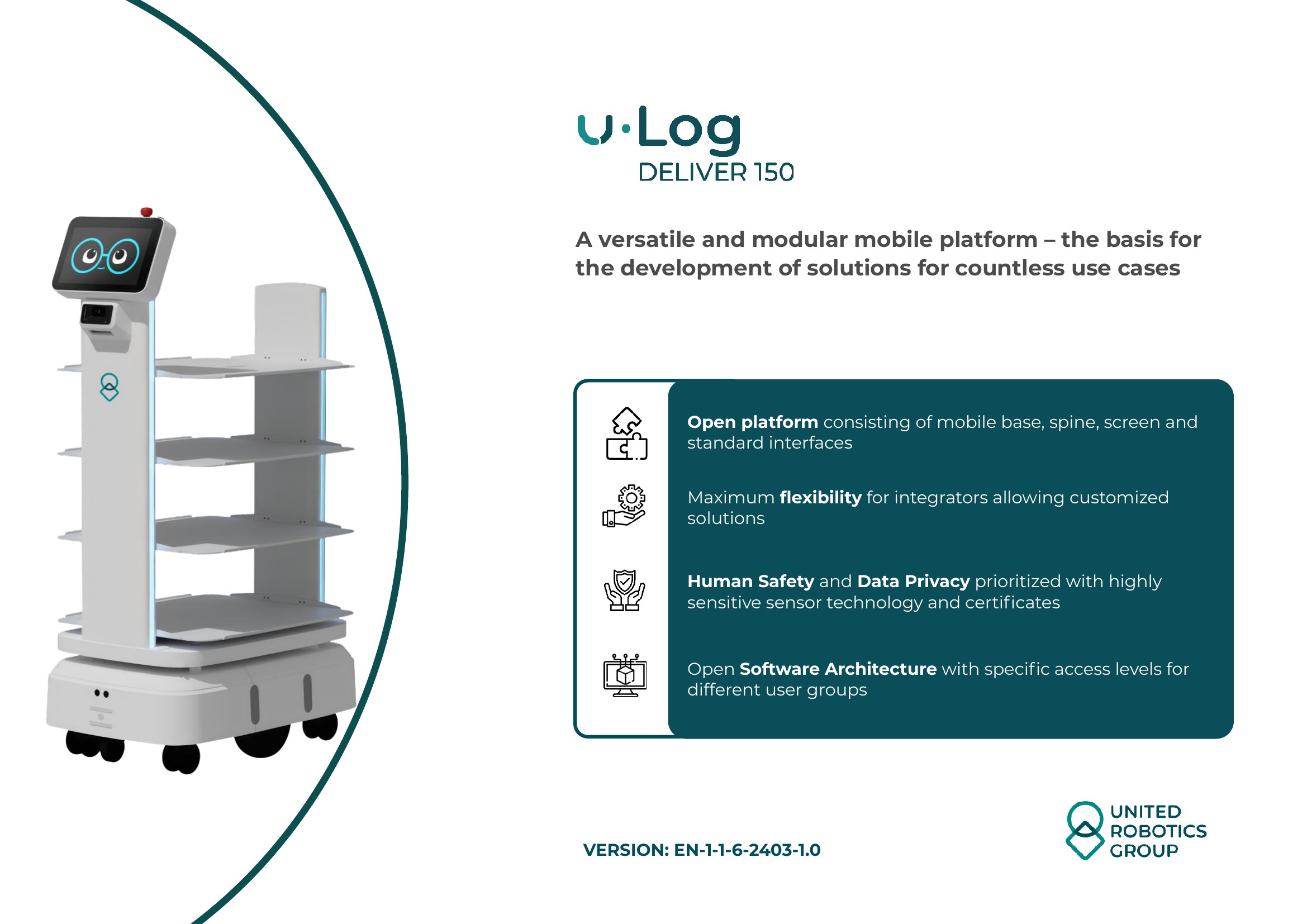
URG Americas' uLog Deliver series exemplifies this flexibility, with the Deliver 80 (80 lb capacity) for standard healthcare delivery, Deliver 150 (150 lb) for expanded requirements, and Deliver 300/300XL for warehouse and heavy logistics applications.
Navigation in Complex Environments
Hospitals and warehouses present navigation challenges far more complex than controlled factory environments. Robots must operate safely alongside human workers, navigate through elevators and multi-level facilities, handle dynamic obstacles, and respond to unexpected environmental changes.
Essential navigation capabilities:
- Multi-floor elevator integration with automatic call buttons, door detection, level awareness
- Obstacle detection and dynamic re-routing with real-time adjustment
- Elevator priority management so robots coordinate with human traffic
- Stairwell avoidance and multi-route planning
- Human prediction and collision avoidance maintaining safe distances
- Environmental adaptation handling different floor types, lighting conditions, seasonal changes
Verify that any robot you evaluate has demonstrated stable operation in 24/7 real-world healthcare or warehouse environments for extended periods (12+ months). Case studies and reference facilities provide invaluable perspective on actual performance versus specifications.
Integration with Existing Systems
Isolated robots generate limited value. Maximum benefit emerges from integration with your existing infrastructure:
- WMS/WDS Integration: Hospital information systems, warehouse management systems, and delivery systems must communicate seamlessly. When a medication order enters the HIS, it should automatically trigger a robot delivery with zero manual intervention.
- Access Control Integration: Robots must pass through locked doors without manual intervention. Electronic lock integration ensures secure delivery while maintaining facility access control.
- Floor Plan Data: Robots require detailed facility maps for efficient navigation. Integration with your building information systems (BIM) or CAD drawings accelerates deployment and maintains accuracy as facilities evolve.
- Analytics and Reporting: Comprehensive data on delivery times, robot utilization, traffic patterns, and bottlenecks enables continuous optimization. Ensure systems provide robust analytics, not just basic operational status.
Strategic Deployment Planning
Phase 1: Pilot Program (Months 1-3)
Begin with a limited deployment targeting your highest-impact use case. In hospitals, this is typically medication delivery from pharmacy to nursing units. In warehouses, it might be bin-to-packing station replenishment.
Goals for pilot phase:
- Validate technology performance in your specific facility
- Train staff and build organizational comfort with autonomous systems
- Identify integration requirements and technical challenges
- Document measured productivity improvements and safety outcomes
- Build stakeholder enthusiasm for expansion
Most successful pilots start with 1-2 robots serving specific departments or warehouse zones. This isolated approach prevents widespread disruption if technical issues emerge while capturing immediate productivity benefits that demonstrate value.
Phase 2: Infrastructure Preparation (Months 2-4, Parallel to Pilot)
While pilots operate, prepare infrastructure for scaling:
- Detailed facility mapping and digital floor plan creation
- IT system integration planning and API development
- Charging station placement and electrical infrastructure
- Staff training program development and delivery
- Safety protocol refinement based on pilot observations
- Maintenance and support procedures documentation
Phase 3: Scaled Deployment (Months 5-12)
Once pilot success is validated and infrastructure prepared, expand to your full deployment target. Rather than adding all robots simultaneously, implement in waves—adding 2-3 robots every 4-6 weeks. This phased approach:
- Allows operators to absorb new robots into workflows gradually
- Identifies and resolves integration issues before they affect large fleets
- Demonstrates increasing benefits, sustaining stakeholder support
- Enables continuous process optimization rather than problematic "big bang" deployments
Phase 4: Optimization and Expansion (Month 12+)
After full deployment, focus shifts to optimization and scaling. Analyze usage data to identify inefficiencies, adjust robot routes and algorithms, expand into new use cases, and plan for fleet growth as operations evolve.
Fleet Scaling and Integration Strategies
Right-Sizing Your Fleet
Optimal fleet size depends on several factors:
Delivery Volume: Quantify your delivery requirements. A hospital pharmacy might process 300-500 medication orders daily. A warehouse might require 1,000+ material movements. Divide required deliveries by robot capacity and coverage to estimate robot quantity.
Operational Hours: Facilities operating 24/7 (hospitals, distribution centers) require different sizing than those with concentrated activity periods (office buildings, retail warehouses). 24/7 operations may benefit from larger fleets despite lower average utilization, because guaranteed availability prevents bottlenecks.
Peak Load Handling: Don't size for average demand—size to handle peak periods. A hospital may process 50 medication deliveries during typical hours but 150+ during shift changes and meal preparation. Your fleet should handle peak without degradation, or your system cannot reliably prevent delays.
Redundancy for Reliability: Build 15-25% redundancy into your fleet. If 4 robots reliably handle your workload, deploying 5 ensures that maintenance and unexpected downtime don't create service gaps.
Multi-Robot Coordination
As fleet size grows, coordination becomes critical. Modern fleet management systems automatically:
- Optimize task assignment: Route deliveries to robots with optimal positioning, rather than assigning sequentially
- Prevent congestion: Coordinate movement through bottleneck areas (elevators, narrow hallways) to minimize wait times
- Manage charging: Schedule robot charging during predictable low-activity periods while maintaining fleet availability
- Balance utilization: Prevent individual robots from becoming hotspots while others sit idle
- Emergency response: Automatically re-route deliveries when robots experience unexpected issues
These coordination algorithms are often the difference between a system that works smoothly and one that becomes increasingly chaotic as robots are added. Evaluate fleet management software as carefully as the robots themselves.
Infrastructure and Technology Requirements
Network and Connectivity
Autonomous robots require robust wireless connectivity. Standard office Wi-Fi frequently proves inadequate for mission-critical robot operation. Evaluate and upgrade your wireless infrastructure:
- Coverage: Wi-Fi signal must reliably reach all operational areas. Coverage gaps create dead zones where robots cannot maintain communication.
- Capacity: Modern robots use 2-5 Mbps continuously. A fleet of 10 robots requires 20-50 Mbps available capacity. Most facilities need capacity upgrades.
- Reliability: Network downtime directly equals robot downtime. Implement redundancy (dual access points, cellular backup) for mission-critical operations.
- Security: Robots connected to your network represent security considerations. Ensure proper network segmentation, VPN requirements, and authentication controls.
Charging Infrastructure
Charging stations must be strategically located to minimize deadhead time (driving to charge rather than delivering). A typical deployment requires one charging station per 3-5 robots for 24/7 operation.
Charging options:
- Manual dock charging: Least expensive but requires human intervention and prevents true autonomous operation
- Auto-dock charging: Robots autonomously find and connect to charging stations. More expensive but enables fully autonomous operation.
- Mobile charging stations: Charging units that follow robots to minimize non-delivery time. Emerging technology with promise for large fleets.
Floor Plan and Mapping Data
Robots require accurate digital maps of your facility. Deployment involves:
- Creating accurate floor plans with obstruction detail
- Marking restricted areas where robots cannot operate
- Defining delivery locations and drop points
- Integrating building system data (elevators, doors, access controls)
- Planning optimal route networks based on facility layout
This mapping becomes a living document maintained throughout the robot lifecycle, updated whenever facility layouts change.
Selection and Evaluation Framework
Use this framework to evaluate autonomous delivery platforms for your specific needs:
- Payload Capacity Alignment: Does the robot handle your typical loads? What are constraints for oversize items? Can it manage temperature-sensitive materials if required?
- Documented Real-World Performance: Can vendor provide case studies of deployment in facilities similar to yours? What are actual delivery times, uptime percentages, and staff satisfaction metrics?
- System Integration Depth: How well does the system integrate with your WMS, HIS, or existing automation? Does integration require custom development or is it native?
- Multi-Floor Capability: If your facility spans multiple levels, does the robot reliably navigate elevators? What elevator integration is required?
- Safety Certification: What safety standards does the robot meet? Has it been validated in patient-facing or public environments?
- Fleet Management Sophistication: Does the fleet management system provide route optimization, collision prevention, and predictive maintenance?
- Vendor Stability and Support: Is the company financially stable with long-term commitment to the platform? What support levels are available?
- Future-Proofing: Can the system adapt to your evolving needs? Does the vendor have roadmap for enhanced capabilities?
- Total Cost of Ownership: What are robot cost, installation, training, maintenance, spare parts, and software licensing over 5-7 years?
- Trial Availability: Can you arrange a pilot period before full commitment? What guarantees does the vendor provide?
Implementation Success Factor
The difference between successful autonomous robot deployments and disappointed ones rarely involves technology. Modern robots are reliable and capable. Success comes from thoughtful planning, staff engagement, realistic expectations, and vendor partnerships that extend beyond the sales transaction into true ongoing collaboration.